
Your General Liability Policy Won’t Save You When It Matters Most
Plaintiffs’ attorneys are deliberately wording lawsuits to dodge your CGL coverage — leaving contractors on the hook for defense costs and big settlements. Here’s why smart contractors never rely on General Liability alone.
GENERAL LIABILITY
Scott Henricks
5/14/20263 min read
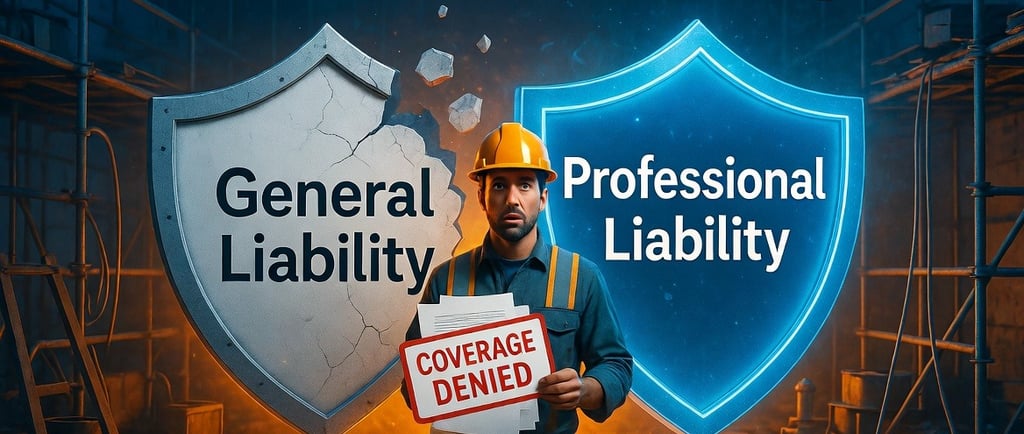
General Liability Isn’t Enough: Why Smart Contractors Need Professional Liability Insurance
In today’s claims environment, plaintiffs’ attorneys have become experts at drafting lawsuits with one goal in mind: to keep your General Liability (CGL) policy from responding. By carefully wording complaints around “professional negligence,” “shoddy workmanship,” “breach of contract,” or purely economic losses, they can leave contractors holding the bill for both defense costs and damages.
If you’re a contractor, understanding this reality isn’t optional — it’s critical to protecting your business.
What Your Commercial General Liability (CGL) Policy Actually Covers
A standard CGL policy is built to handle third-party claims for bodily injury and property damage caused by an occurrence — meaning sudden, accidental events. It works well when your operations cause unexpected harm to people or other people’s property.
However, CGL is not a warranty for the quality of your work. It typically excludes:
Damage to “your work” (the cost to repair or replace your own defective workmanship)
Purely economic losses
Claims involving professional services, errors, or omissions
This is where many claims fall through the cracks.
Real-World Examples:
A plumber installs a fitting incorrectly, causing a slow leak. If the homeowner sues only for the cost of tearing out and replacing the faulty plumbing, most CGL policies deny coverage — that's damage to "your work." But if the leak also damages hardwood floors or cabinetry, CGL usually responds to that "other property" damage, while still excluding the cost to fix the original plumbing.
An electrician makes a poor connection that leads to a claim for "negligent workmanship" or "failure to install per code." If the suit focuses on the cost to correct the wiring, the CGL carrier often has no duty to defend. If that same bad connection causes a fire, the policy may cover the fire damage — but still exclude the cost of the original fix.
A general contractor is brought in to consult on a project — reviewing plans, advising on approach, or offering technical judgment outside the physical construction work. When that advice is later blamed for a costly problem, GL and WC don't respond at all. The moment a GC gives advice or professional opinion beyond hands-on construction, it becomes a professional service — and that's a different exposure entirely.
You Have Zero Control Over How the Lawsuit Is Written
Here’s the most important point every contractor must understand: You have no say in how the plaintiff’s attorney drafts the complaint.
Carriers determine their duty to defend based on the "four corners" rule — comparing the allegations to the policy language. Even if the underlying facts might suggest some coverage, a skillfully worded complaint alleging professional negligence or breach of contract can remove the claim entirely from CGL coverage.
This isn't a policy defect. It's how liability insurance is structured. The carrier follows the policy wording — the same way you'd expect them to pay when coverage clearly applies.
Why Professional Liability Coverage Is No Longer Optional
Contractors Professional Liability (also called Errors & Omissions, or E&O) is built to close these gaps. It responds to claims arising from negligent acts, errors, or omissions in your professional services — even when there's no traditional property damage.
It can protect you when allegations involve:
Installation techniques or professional judgment
Project supervision and coordination
Consulting, design input, or advisory roles on a project
Failure to meet expected standards of workmanship
Economic losses and corrective work costs
Carrying both CGL and Professional Liability creates layered protection. When claims have mixed elements — which most do — the two policies can work together, reducing your out-of-pocket exposure and giving you a more seamless defense.
Bottom Line for Contractors
Relying solely on General Liability in today's legal climate is a risky gamble. Plaintiffs' attorneys know exactly how to plead around your CGL coverage, and the cost of being wrong can be devastating to your business.
The most successful contractors treat Professional Liability as a core part of their insurance program — not an afterthought.
Next steps:
Review your current policies with your broker
Ask about Contractors Professional Liability options and appropriate limits
Strengthen contract language and job documentation habits
Want a no-cost review of your current coverage? [Contact us].
This article is for educational purposes only and does not amend or replace your actual policy wording. Coverage depends on specific policy terms, endorsements, and applicable state law.
Get in touch with our experts today
23052 Alicia pkwy, suite H378, Mission Viejo, CA 92692
Call:
(949) 305-5577
CA Lic# 0F56527
FL Lic# L129585
© 2026. All rights reserved.
11582 SW Village Pkwy, #545, Port St Lucie, Fl 34987
Call: (772) 254-9221