
2026 Workers Compensation Market Outlook
An Executive Summary of the 2026 Workers Compensation insurance market
WORKERS COMPENSATION
2/12/20267 min read
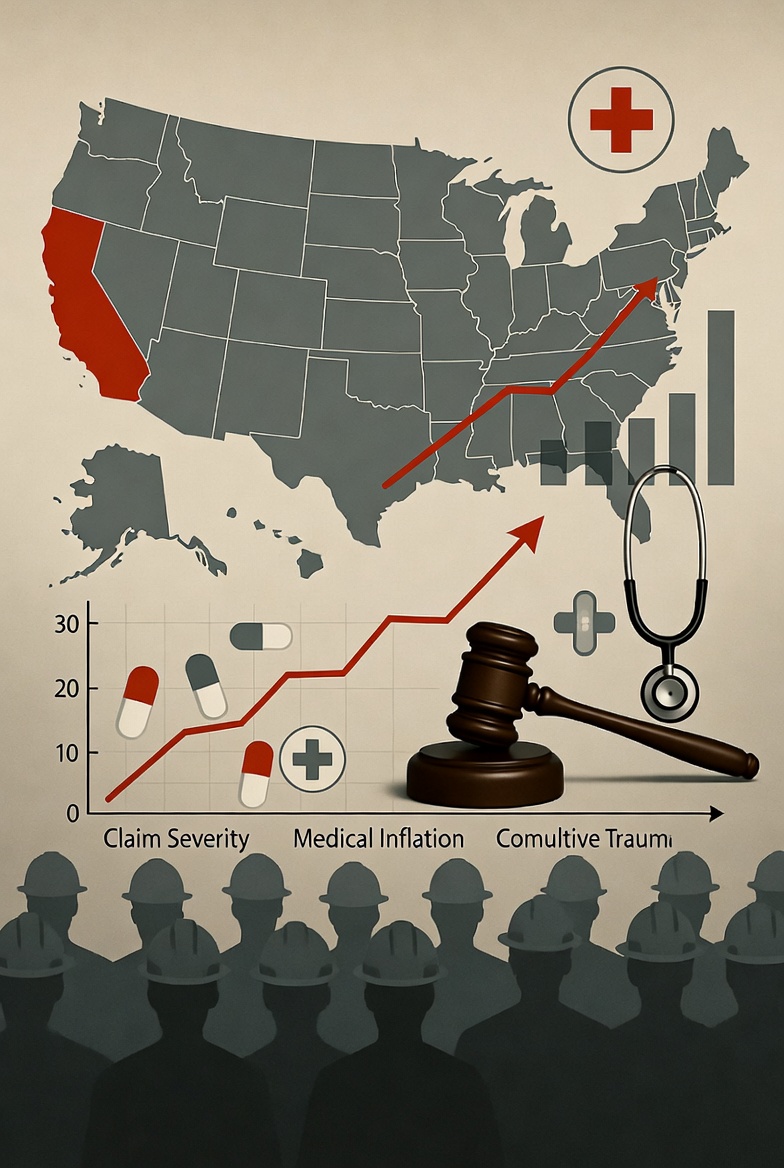
The U.S. workers' compensation sector is undergoing a significant transition as it approaches 2026. Following almost ten years of falling premiums and stable conditions, insurance providers are now dealing with a changed environment marked by rising healthcare costs, ongoing lawsuits related to repetitive injuries, and questions about the sufficiency of loss reserves.
Social inflation, driven by large jury awards often linked to vehicle collisions, is increasing the intensity of claims in California and other regions. Insurers are reevaluating their reserve levels as actual payouts exceed earlier estimates, which is expected to affect premium structures and policy offerings. California serves as a leading indicator for the rest of the country. Accounting for roughly 25% of the national market, the state's 2024 combined loss ratio climbed to 123%, its peak in nearly 15 years. This prompted the state's Insurance Commissioner to authorize an 8.7% rise in average pure premium rates(effective September 1, 2025) , for new and renewal policies, the first such adjustment in a decade, effective September 1, 2025, for new and renewal policies. Underlying factors include surging medical expenses, more frequent and severe claims (particularly those involving repetitive strain), and elevated legal fees, which have built up to a tipping point.
Healthcare cost increases are a major contributor to higher claim values, with the Workers' Compensation Weighted Medical Price Index showing annual inflation of 2% to 3.5%. The rise of mixed work setups adds further complications, as it muddles distinctions between job-related and personal injuries, calling for new approaches to control expenses amid shifting work patterns.
Advances in technology and data analysis for workplace safety are crucial for mitigating claims and costs, using forecasting tools, artificial intelligence for oversight, and sensor-equipped gear to boost safety and regulatory adherence.
California's trends are seen as preceding those in other states by about 18 to 24 months. The sector is facing disruption, especially for insurers that have pursued growth aggressively without maintaining profitability, potentially leading to major difficulties.
Monitoring developments in state regulations, including expanded coverage for psychological injuries and issues with remote work claims, is essential for compliance and planning.
Market Trends in 2025
California's premium environment has shifted dramatically, prompting a reassessment of what was once viewed as a reliable insurance line after consistent declines over the past decade. Rates had dropped to levels not seen in 50-60 years, but the Commissioner endorsed an 8.7% average increase across categories.
While the overall 8.7% uptick in pure premium rates might appear moderate, deeper analysis reveals sharper changes. In sectors like manufacturing and education, rates are climbing more than 20% annually, with some classifications surpassing 30%.
The extended period of low rates shifted attention away from workers' compensation toward steeper rises in other property and liability areas, masking the line's weakening basics.
Insurers' risk selection and evaluation standards are tightening. California's combined ratios have topped 100% for five straight years, hitting over 123% recently, far above national figures. This surge stems from growing medical expenses, more litigation, and expanding repetitive injury claims, leading providers to overhaul their approaches.
Major insurers are adjusting their portfolios. In California, policies are under close review, with possibilities of cancellation or premium hikes. Market capacity remains available, but providers are scrutinizing their holdings and refining tactics.
Non-renewals have risen notably this year in California compared to prior periods. Providers are boosting minimum premiums, with base rates up 20%. Credits from the previous year are being withdrawn, and debits added in some instances—even for accounts with no claims.
As claim loads grow, insurers are seeking better rate alignment and imposing surcharges where experience modifiers (mods) have worsened. The mod adjusts premiums based on a business's claim history relative to peers—elevated mods result in higher charges. Overall, renewal net rates are rising up to 27% year-over-year, including for low-loss accounts.
Claim reserves across the industry are being examined as outcomes surpass forecasts. In California, projected excess reserves have declined steeply, from $17 billion in 2017 to $3 billion in 2024, per the WCIRB. Continuing at this rate, the buffer might vanish in two to three years, turning into a shortfall. The broader question is if other states will mirror California's path.
Trends Beyond California
In areas outside California, workers' compensation remains largely viable, with calendar-year combined ratios at 86%-89% and accident-year ratios around 99%, much better than California's figures. Some decline in accident-year ratios has occurred, varying by insurer and data from sources like the NCCI.
Nevada saw a 6.5% rate hike, an outlier based on NCCI information. This March 1, 2025, change was due to escalating loss expenses and higher claim rates, a big step up from the 1.8% rise in 2024 and the first substantial shift after years of minor increases.
Several states saw rate reductions in 2025:
Connecticut: 6.1% average drop in voluntary market premiums, approved by the Insurance Department in November 2024.
West Virginia: 9.1% cut, the 20th year in a row, saving employers about $15,000 on average.
Massachusetts: 14.6% decrease—the fifth consecutive—yielding $181,000 in annual premium savings and an estimated $87 million for businesses.
Missouri: 5.3% reduction for 2025, the fourth straight year, reflecting lower average indemnity and medical costs per claim.
Rising Medical Expenses and Claim Intensity
After a period of steadiness, medical costs are surging from various angles. California's average indemnity claim hit nearly $80,000 in 2024, altering the risk profile for all involved.
A key driver is the 2021 shift in med-legal fees to per-page billing, which has caused substantial increases. Consequently, lower-value claims have become more expensive, especially non-severe ones. Many involve cumulative trauma (CT), like repetitive motion issues, adding to the cost escalation.
Statewide, CT now makes up almost 25% of indemnity claims, a record high, with California at the forefront nationally.
The CMS forecasts healthcare expenditures growing 5.4% yearly through 2028, with Medicare seeing the quickest rise amid persistent inflation worries.
Med-legal expenses have grown 30% in the last four years. Per-page charges for records have empowered claimant lawyers to inflate what were once minor claims.
The pandemic temporarily lowered claim reports and treatments, skewing premium bases downward. As facilities reopened and workers returned to offices, filings sped up, necessitating rate corrections.
Post-COVID patterns show a truer picture. In CT cases, some avoid standard protocols and opt for expensive custom drugs, driving up expenses markedly.
California's rising combined ratios result from a confluence of issues:
Medical Inflation: Healthcare prices continue to climb after the pandemic, influenced by changes in procedures like surgeries and therapy usage.
Wage Inflation: This has boosted indemnity payouts, with California's minimum wage rising to $16.90 per hour on January 1, 2026.
Telelegal Expansion: Virtual litigation has allowed attorneys from high-cost areas like Los Angeles to handle cases statewide, with remote hearings at 80%-85% in 2023-2024, spreading costly practices.
Aging Labor Force: Younger individuals are moving to freelance work, leaving older employees in conventional jobs, which correlates with more injuries and extended healing periods.
Claim Intensity by Type and Sector
Claim rates differ by field, with low incidence among remote office staff, healthcare-specific injury trends, and automation effects in service industries. Frequency for office roles stays minimal for ongoing remote workers.
NCCI data indicates the highest-cost lost-time claims stem from vehicle crashes, averaging over $100,000, followed by burns at about $63,119. These numbers show how one major incident can impact smaller policies severely.
Wage growth has notably increased indemnity costs.
Regulatory and Legal Developments
Presumptive coverage laws are spreading quickly. These provide assumed benefits for first responders and firefighters for issues like PTSD, specific cancers, and chronic conditions tied to job hazards.
By July 31, 2024, NCCI tracked 64 proposals on mental health in workers' compensation, 51 focused on PTSD. These updates aim for broader, more informed protection.
Higher pay leads to elevated indemnity payments, adding strain. Insurers must factor in greater expenses for workers sidelined by injuries.
The gig economy poses classification issues between employees and freelancers, leading to potential coverage shortfalls. Gig workers are usually contractors, handling their own insurance, which excludes them from typical policies and often leaves them underprotected.
Determining eligibility for remote or gig injuries involves assessing location, timing, and task connection.
Regional Variations: Dynamics and Adjustments
California: A Shifting Landscape
California often precedes U.S. trends by 1.5 to 2 years. As conditions toughen, rate increases aim to offset insurer deficits from medical inflation and rising costs.
CT claims are costlier, more disputed, and slower to settle, with growing numbers. This is pronounced in lower-pay fields like building trades, where untreated repetitive issues evolve into complex cases.
Businesses are turning to non-traditional funding options. Captive insurance is popular for workers' compensation, often combined with auto and liability lines. This approach, starting in the Northeast, is spreading countrywide.
Self-insured collectives, which rose during the early 2000s crisis, could regain popularity as insurers withdraw or hike rates sharply.
Florida: The Fixed-Rate Hurdle
Florida functions under a fixed-rate system, requiring uniform base charges across all insurers. No adjustments for credits or surcharges are permitted, restricting adaptability.
This setup makes Florida less appealing nationally. Many providers avoid it due to historically low rates, hindering adequate compensation for risks.
Florida experienced a slight 1% rate drop in 2025, among the smallest recently, due to falling serious claim rates and legal changes.
For 2026, NCCI suggests a 6.9% reduction, the tenth in a row, totaling nearly 80% over two decades.
Sector-Specific Insights
Workers' compensation patterns vary by industry, each with distinct risks and shifts.
Construction: Worker shortages affect experience ratings and loss figures as firms fight to keep teams safe. Combined with material delays, this prolongs projects and raises expenses.
The growing frequency and cost of third-party liability claims have led insurers to restrict options for construction firms in certain locations, such as New York City's boroughs.
Healthcare: Staff encounter more violence and attacks, posing major risks to operations. Injuries from lifting patients and repetitive tasks persist, while stress-related mental claims are increasing, frequently classified as CT.
Public Sector: This area sees the biggest regulatory and cost transformations. Presumptive claims for emergency personnel are expanding, including PTSD, cancers, and exposure-linked ailments.
Cyber threats, staffing gaps, policy changes, and severe weather are reshaping the sector, necessitating targeted risk controls and tailored insurance.
Temporary Staffing: After a post-pandemic payroll boom, this field has decelerated sharply. Over recent months, actual payrolls have undershot estimates significantly, leading to premium refunds and interim reviews.
The downturn affects various areas like building, medical, and administrative roles. Most report payroll monthly, consistently below projections.
Joint liability issues are rising, along with complications in assigning experience mods for agencies and their agents.
Hospitality: The sector is integrating automation, AI, and robotics to streamline operations and improve guest interactions. However, this raises issues around employment displacement, moral concerns, and loss of human elements central to service.
Following the pandemic, wage and payroll inflation has been notable, spurred by new laws in states like California and Illinois establishing higher minimum and living wages, altering cost frameworks.
This regulatory evolution has driven up payrolls for dining and lodging businesses, influencing premium bases and claim risks as providers adapt.
Outlook for 2026
Insurers are maneuvering through a dynamic setting influenced by California's patterns and wider pressures.
Swift adjustments may occur ahead. After a prolonged soft period, shifts often happen abruptly and more intensely than anticipated. Providers might pursue notable and ongoing rate hikes to address underpriced exposures.
Key points include escalating premiums and minimums, greater selectivity in accepted risks, and reduced availability in some segments.
Active risk mitigation will be key in defining success in 2026, positioning entities to enhance their profiles and adapt effectively. This will distinguish top performers from others.
This analysis is based on insights from the "2026 US Workers' Compensation Market Outlook" report by Risk Placement Services (RPS).
Get in touch with our experts today
23052 Alicia pkwy, suite H378, Mission Viejo, CA 92692
Call:
(949) 305-5577
CA Lic# 0F56527
FL Lic# L129585
© 2026. All rights reserved.
11582 SW Village Pkwy, #545, Port St Lucie, Fl 34987
Call: (772) 254-9221